
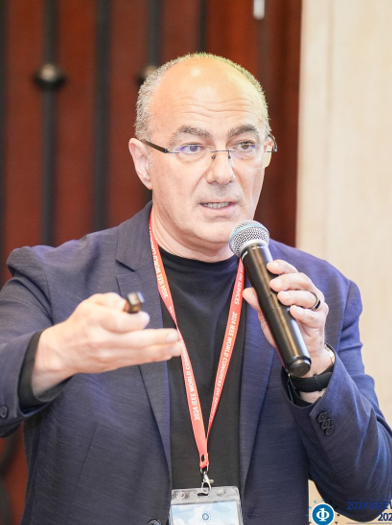
 | Prof. Schahram DustdarIEEE Fellow, Asia-Pacific Artificial Intelligence Association (AAIA) FellowACM Distinguished Scientist, ACM Distinguished SpeakerMember of the Academia EuropaeaProfile: Schahram Dustdar is Full Professor of Computer Science heading the Research Division of Distributed Systems at the TU Wien, Austria. He holds several honorary positions: Francqui Chair Professor at University of Namur, Belgium (2021-2022), University of California (USC) Los Angeles; Monash University in Melbourne, Shanghai University, Macquarie University in Sydney, University Pompeu Fabra, Barcelona, Spain. From Dec 2016 until Jan 2017 he was a Visiting Professor at the University of Sevilla, Spain and from January until June 2017 he was a Visiting Professor at UC Berkeley, USA. From 1999 - 2007 he worked as the co-founder and chief scientist of Caramba Labs Software AG in Vienna (acquired by Engineering NetWorld AG), a venture capital co-funded software company focused on software for collaborative processes in teams. Caramba Labs was nominated for several (international and national) awards: World Technology Award in the category of Software (2001); Top-Startup companies in Austria (Cap Gemini Ernst & Young) (2002); MERCUR Innovation award of the Austrian Chamber of Commerce (2002). He was founding co-Editor-in-Chief of ACM Transactions on Internet of Things (ACM TIoT) as well as Editor-in-Chief of Computing (Springer). He is an Associate Editor of IEEE Transactions on Services Computing, IEEE Transactions on Cloud Computing, ACM Computing Surveys, ACM Transactions on the Web, and ACM Transactions on Internet Technology, as well as on the editorial board of IEEE Transactions on Big Data, IEEE Internet Computing, IEEE Computer and of many more. Dustdar is recipient of multiple awards: TCI Distinguished Service Award (2021), IEEE TCSVC Outstanding Leadership Award (2018), IEEE TCSC Award for Excellence in Scalable Computing (2019), ACM Distinguished Scientist (2009), ACM Distinguished Speaker (2021), IBM Faculty Award (2012). He is an elected member of the Academia Europaea: The Academy of Europe, where he is chairman of the Informatics Section, as well as an IEEE Fellow (2016), an Asia-Pacific Artificial Intelligence Association (AAIA) President (2021-2023) and Fellow (2021). He is an EAI Fellow (2021) and an I2CICC Fellow (2021). He is a Member of the 2022 IEEE Computer Society Fellow Evaluating Committee (2022) and Chair of the Advisory Board of the National Edge AI Hub (led by Newcastle University, UK). |
 | Prof. Shuiping ShiJinan University, ChinaProfile: PhD in Management (Accounting) from Sun Yat sen University, International Registered Anti Fraud Specialist, Visiting Scholar at Boston University and City University of Hong Kong, Professor at the School of Management of Jinan University, Executive Director of the Huashang Case Study Center, Deputy Director of the Finance, Taxation and Risk Control Center, Vice President of the Guangdong Management Accountants Association and Executive Dean of the GAMA Greater Bay Area Research Institute, Director of the Guangdong Audit Society, Executive Director of the Guangzhou Audit Society, Expert Committee Member of the Guangdong Enterprise Internal Control Association, and Independent Director of multiple listed companies. Has won the Ministry of Finance's "Yang Jiwan Accounting Award", "Guangdong Provincial People's Government Philosophy and Social Science Excellent Achievement Award", "MPAcc National Excellent Teaching Case", "MAud National Excellent Teaching Case", and "ACCA National Excellent Guidance Teacher". Hosted 8 sub projects of National Natural Science Foundation of China, National Social Science Foundation of China, Key Soft Science Projects of Guangdong Province, Natural Science Foundation of Guangdong Province, and Social Science Foundation of Guangdong Province, and participated in nearly 10 national and provincial-level research projects. Published over 40 academic papers in important domestic and international journals such as Journal of Environmental Protection and Ecology, Financial Research, Economic Dynamics, Financial Research, and Management Science. Independently participated in the publication of 6 monographs and case collections, and served as an anonymous reviewer for journals such as China Finance Review International, Accounting Research, China Management Science, and Nankai Management Review. Speech Title: Enterprise Risk Management Framework: Integrating with Strategy and Performance Abstract: In September 2017, the COSO Committee launched a new version of the Enterprise Risk Management Framework, which underwent substantial changes compared to the 2006 draft for soliciting opinions. In the official version of the enterprise risk management framework, compared to the draft for soliciting opinions, the title of the framework has undergone a subtle change from "Enterprise Risk Management Marking with Strategy and Performance" to "Enterprise Risk Management Integrating with Strategy and Performance". This change, although only between "Aligning" and "Integrating", carries profound meaning. It not only reveals the evolution of the core concepts of the entire framework from the draft for soliciting opinions to the official version, but also reflects COSO's repositioning of the risk management role - from a single risk response to a deep integration with corporate strategy. This transformation undoubtedly brings a new perspective and deeper challenges to enterprise risk management. |
 | Prof. Zhengang ZhangSouth China University of Technology,ChinaProfile: Zhang ZhengangSecond-Grade Professor, Doctoral Supervisor, South China University of TechnologyBEng, MEng, PhD in Management, South China University of TechnologyMBA, University of Hull, UK (Studied on a national government-sponsored scholarship)Director, Guangzhou Digital Innovation Research Center, Guangdong Key Research Base of Soft Science, Guangdong Think Tank for Science and Technology Revolution and Technology ForesightRecipient of the Program for New Century Excellent Talents in University (Ministry of Education), High-Level Talent of the "Special Support Program" of Guangdong Province, and Excellent Popularization Expert of Social Sciences of Guangdong Province Speech Title: Leading the Three Major Transformations of Scientific Research Paradigms with Artificial Intelligence Abstract: The research logic has shifted from hypothesis-driven to data-driven: artificial intelligence is leveraged to mine patterns in massive datasets and generate new hypotheses. The research methodology has evolved from single-point experiments to virtual simulation: AI-enabled virtual environments are built to improve research efficiency. The research organization has transformed from individual-led to collaborative intelligence: AI breaks down barriers to realize the integration of resources and intellectual insights. |
 | Xianyuan WenSenior Researcher (Grade II) / Former Vice PresidentGuangdong Academy of Social SciencesProfile:Former Vice President of Guangdong Academy of Social Sciences. Second level researcher. Expert enjoying special government allowances from the State Council, chief expert for major bidding projects of the National Social Science Fund, expert for project evaluation of the National Social Science Fund, expert for evaluation of the Degree Center of the Ministry of Education, expert for evaluation of the 14th Five Year Plan for Philosophy and Social Sciences in Guangdong Province, etc.The research areas involve philosophy and culture, technological innovation and policy, cultural industries and policies, and the sinicization of Marxism. Speech Title:From“digitalization”to“digital transformation”:The cultural logic of digital intelligence technology generated by the digital society Abstract:The deepening of the digital society is reconstructing the reality. This article summarizes and explores the connotations and characteristics of "digitalization", "digital transformation", and "digital transformation". Digital transformation triggers changes in values and promotes civilized innovation in digital transformation. It has significant theoretical and practical significance for deepening research on the cultural logic of digital technology generated by digital society. |
 | Assoc. Prof. Pedro IsaiasUniversidade Aberta (UAb), PortugalProfile: Pedro Isaías is an associate professor at Universidade Aberta (Portuguese Open University) in Lisbon, Portugal. Pedro was an associate professor at the Information Systems & Technology Management School of The University of New South Wales (UNSW – Sydney), Australia, an associate professor at The University of Queensland, Brisbane, Australia, and also an invited professor at ISEG-University of Lisbon, Portugal. At Universidade Aberta, he is currently responsible for several courses in the Information Systems areas. At Universidade Aberta, Pedro was director of the master degree program in Management / MBA and also director of the master degree program in Electronic Commerce and Internet for 10 years. He is co-founder and president of IADIS – International Association for Development of the Information Society, a scientific non-profit association. Author of several books, book chapters, papers and research reports, all in the information systems area, he has headed several conferences and workshops within the mentioned area. He has also been responsible for the scientific coordination of several EU funded research projects and has had participation as a principal investigator in various research projects. Currently he conducts research activity related to MIS in general, and more specifically Learning Technologies, Data Analytics, Business Intelligence, Digital Transformation, e-Business and WWW related areas. Pedro has more than 196 publications: 33 journal papers, 75 conference papers, 10 authored books, 33 edited books, 24 book chapters, and 21 journal special issues. Pedro has delivered 33 keynote/invited talks & workshop panels and has received over 4,763 citations, resulting in an h-index of 35 (Google Scholar, December 2025). Speech Title: Chatbots and Digital Transformation: From Use Cases to Systemic Change Abstract: This keynote presentation will address the impact of chatbots on Digital Transformation, focussing on isolated examples of application to key players that drive systemic changes in the Digital Economy. Based on AI recent developments, this talk discusses how chatbots are being implemented in various sectors such as Education, Business, Healthcare, and Government. These implementations facilitate scalability, automation, and also innovative value creation. Conversely, we have potential risks related to a widespread use such concerns about privacy, security, excessive automation, and reduced quality of human interaction. Lastly it will be covered the importance of viewing chatbots as socio-technical systems and their role in transforming organisations and society. |